English
 English

 Home
HomePVC Pipe Extrusion Line
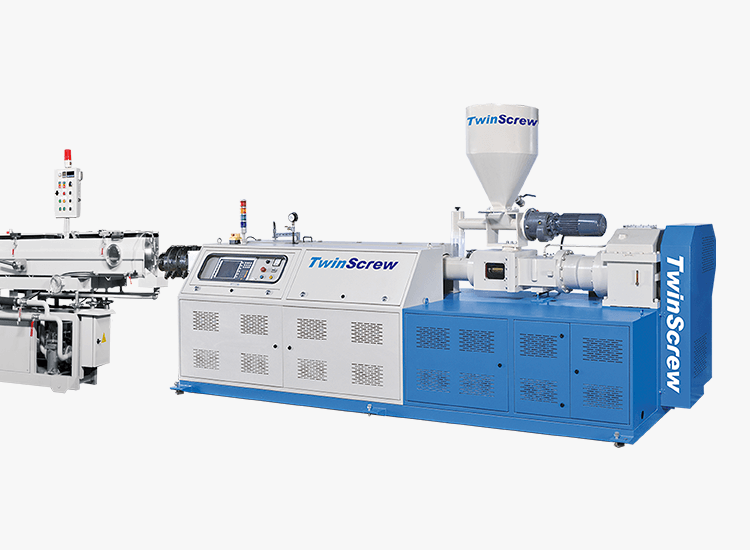
A PVC pipe extrusion line melts rigid PVC dry blend in a counter-rotating twin screw extruder, forms it through a spider die into a continuous tube, holds the diameter under vacuum while the wall cools, then cuts each length and forms the socket at one end. Our lines cover 60 mm to 630 mm at 150 to 1,000 kg per hour.
PVC pipe is sold on a pressure rating, not on a diameter. That rating assumes the wall is the stated thickness everywhere, so a line that holds outside diameter perfectly while the wall drifts thin on one side produces pipe that measures correctly and fails a burst test. Wall uniformity comes from melt homogeneity in the extruder and from even distribution in the die.
Tell us the diameter range, the pressure class you are building to, and your target output in kilograms per hour. Those three answers pick the extruder model and decide whether a single line or a dual line layout is the cheaper way to reach your tonnage.
Single Line or Dual Line: Where the Output Comes From
Once the diameter range is settled, the next decision is how to reach your tonnage, and there are two ways to do it. The choice matters most at the small end of the range:
| Single line | Dual line | |
|---|---|---|
| Strands | One pipe from one die head | Two pipes from one extruder |
| Best for | The full diameter range, including large bore | Small diameter conduit and plumbing pipe |
| Output per extruder | Set by extruder size | Roughly doubled at small diameters |
| Downstream | One cooling tank, haul-off, saw, beller | Paired downstream on both strands |
| Floor space per ton | Higher | Lower |
Small pipe is where a single line wastes capacity: a 75 mm extruder pushing 20 mm conduit is limited by how fast the cooling tank can take the heat out, not by how much melt the screw can deliver. Running two strands uses that spare melt capacity instead of leaving it idle. Above roughly 160 mm the argument disappears, because one strand already absorbs everything the extruder can produce.
What a PVC Pipe Line Produces
One line covers a family of pipe products, separated by diameter, wall thickness and the additive package rather than by the machine:
- Pressure pipe for water supply. Tight wall tolerance, socket formed in line, the largest share of most producers' output.
- Electrical conduit. High filler loading and thin wall, usually the smallest diameters and the strongest case for a dual line.
- Sewer and drainage pipe. Larger diameters, heavier wall, lower pressure class.
- Well casing and agricultural pipe. Threaded or socketed depending on the market.
- Column pipe and industrial pipe. Specified case by case against the compound.
Rigid PVC tolerates a high percentage of mineral filler, which is why conduit and drainage pipe can be produced at a compound cost that other materials do not reach. A counter-rotating twin screw is what makes a heavily filled dry blend processable, because it conveys positively rather than relying on friction.
How PVC Pipe Is Made
A complete PVC pipe production line runs six stations, each sized against the largest diameter in your range rather than the most common one:
- Dry blend preparation. A high-speed mixer brings PVC resin, stabilizer, filler and lubricant to an even blend. PVC pipe runs from dry blend rather than pellets, which removes a compounding step and is where most of the material cost advantage sits.
- Twin screw extruder. A parallel counter-rotating twin screw plasticizes the blend with self-regulating screw thermoregulation, a sealed water cooling system and vacuum scavenging to pull off moisture and volatiles. Melt pressure control at the screw tip is what keeps output steady, and steady output is what keeps wall thickness inside tolerance.
- Spider die. The spider design gives an even residence time across the whole flow cross-section and distributes the melt homogeneously around the circumference. Even residence time matters more with PVC than with polyethylene, because PVC that sits too long at melt temperature degrades rather than simply cooling.
- Vacuum spray cooling tank. Vacuum holds the outside diameter against the sizing sleeve while spray water carries heat out of the wall. On heavy wall this station sets line speed, and lengthening it is how output is raised.
- Haul-off. Pulls the pipe at a speed matched to extruder output, with grip spread over enough track that the pulling force does not deform the pipe.
- Traveling saw and belling machine. An automatic traveling saw cuts to length while the pipe keeps moving. The belling machine then reheats one end and forms the socket, so pipe leaves the line ready to join rather than needing a separate coupling.
Belling is the station that separates a PVC line from a polyethylene one. Polyethylene pipe is joined by fusion welding on site, so it leaves the line as plain cut lengths; PVC pipe is joined by a solvent-welded socket, so the socket has to be formed while the pipe is still in the factory.
Line Sizes and Output
Four extruder sizes cover the full range, and the model is chosen by the largest pipe you intend to run rather than by the tonnage alone:
| Model | Pipe diameter | Output |
|---|---|---|
| TSE-75-RP-S | 60, 75, 90, 110, 140, 160 mm | 150 to 300 kg/hr |
| TSE-90-RP-S | 90, 110, 140, 160, 200, 250 mm | 300 to 450 kg/hr |
| TSE-110-RP-S | 160, 200, 250, 315, 400 mm | 300 to 450 kg/hr |
| TSE-130-RP-S | 400, 450, 500, 560, 630 mm | 800 to 1,000 kg/hr |
All four run PVC compounding. We have been building computerized pipe extrusion lines for more than thirty-five years, and the model tables are a starting point rather than a catalog: the die, the cooling length and the downstream equipment are matched to your actual diameter mix.
FAQ
What is a PVC pipe extrusion line?
A PVC pipe extrusion line melts rigid PVC dry blend in a twin screw extruder, forms it through a spider die, cools it under vacuum, then cuts to length and forms a socket. Six stations: dry blend, extruder, die, cooling tank, haul-off, saw and beller.
How is PVC pipe manufactured?
From dry blend, not pellets. Resin, stabilizer, filler and lubricant are mixed, melted in a counter-rotating twin screw, pushed through a spider die, sized under vacuum, cut by a traveling saw and belled at one end.
Why does PVC pipe use a twin screw extruder?
Because it runs from powder and carries a high filler load. A counter-rotating twin screw conveys dry blend positively and keeps residence time short, while a single screw conveys by friction and is harder to hold at a stable melt temperature.
What is a belling machine and why does a PVC line need one?
It reheats one end of each cut length and forms it into a socket. PVC pipe is joined by solvent welding one pipe into the socket of the next, so the socket has to exist before the pipe leaves the factory. Polyethylene is fusion welded on site and needs none.
When is a dual line worth it?
At small diameters. A 75 mm extruder running 20 mm conduit is limited by cooling, not melt capacity, so a second strand uses output that would otherwise sit idle. Above roughly 160 mm the advantage disappears.
What do you need to quote a PVC pipe line?
Three things: the diameter range, the pressure class, and the output in kilograms per hour. Tell us your compound and filler loading and we will confirm the model and the layout.
Applications Product
Related Machines