English
 English

 Home
HomePlastic Profile Extrusion Line
A plastic profile extrusion line melts PVC, polyethylene (PE) or polystyrene (PS), pushes the melt through a shaped die, and locks the cross-section under vacuum before it cools — window frames, ceiling panels, decking, rain gutters, cable trunking and door panels all come off the same line with a different die and calibrator.
The die and the calibrating system, not the extruder, decide whether that cross-section holds dimension. Lines specified on extruder output alone are the ones that come back for retooling once the first production drawing arrives.
Send us the cross-section drawing, the wall thickness and the output you need, and we will tell you which extruder, die and calibration length that profile actually requires before you commit to a floor layout.
What Comes Off a Plastic Profile Extrusion Line
One line covers a whole product family, because the profile shape lives in the tooling rather than in the machine. These are the profiles we currently build lines for:
- Window and door frames — rigid PVC, multi-chamber hollow sections
- Ceiling panels — wide, thin-wall hollow profiles
- Decking and skirting board — foamed PVC, solid or celuka structure
- Rain gutters and downpipes — large open sections
- Cable trunking — U and C profiles with snap-fit lids
- Door panels and hollow roofing sheet — large-volume, wide-die work
Each of those has its own application page with the line configuration we normally quote for it. What follows applies to all of them.
The Six Stations of a Plastic Profile Extrusion Line
A complete line runs six stations in sequence, and each one is specified against your profile drawing rather than picked from a catalog:
- Material handling and mixing. Dry blend or pellet feed, dosed into the extruder throat. Rigid PVC formulations are usually fed as dry blend, which is why the feed section and the mixer are specified together rather than separately.
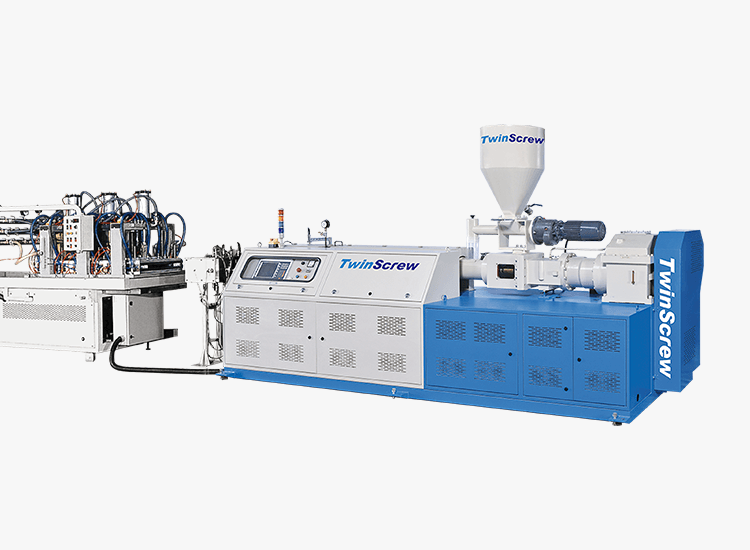
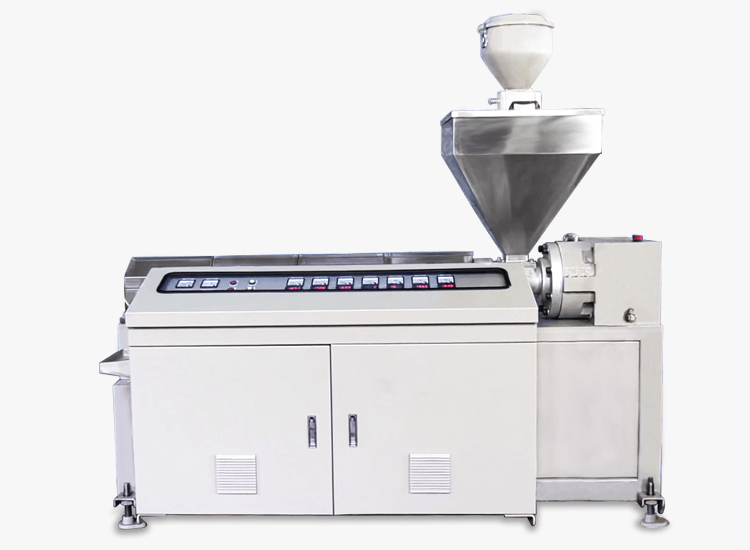
- Main extruder. We build both parallel counter-rotating twin screw extruders and single screw extruders. Rigid PVC dry blend goes on the twin screw; PE and PS profiles generally run on the single screw. The choice sets melt temperature control and therefore surface finish.
- Extrusion tool (die). Our dies are segment-type, machined from stainless steel alloy and zoned for independent heating. Segment construction is what lets a worn or damaged section be replaced without recutting the whole tool.
- Calibrating system. Mounted on a common base plate, with sectional calibration and enough vacuum and cooling water connections to hold the section as it solidifies. This is the station that hollow and foamed profiles live or die on.
- Profile caterpillar haul-off. Pulls the calibrated profile at a speed matched to extruder output. Haul-off speed stability, not extruder speed, is what shows up as wall thickness variation down the length.
- Saw. Cuts to length in line, synchronized with the haul-off.
Two optional stations sit after the saw when the profile needs a decorative surface: our PVC wood-grained printing and ultraviolet (UV) curing equipment, which is normally specified at the same time as the line rather than retrofitted.
How Your Profile Changes the Line
Three properties of your cross-section drive most of the configuration, and they are worth checking before you ask anyone for a price:
- Solid, hollow or foamed. Hollow and foamed sections need sectional vacuum calibration; a solid profile of the same width does not. This is the single biggest cost difference between two lines that look identical on a spec sheet.
- Wall thickness. Thick walls need longer calibration and cooling, which lengthens the line rather than enlarging the extruder.
- Overall width. Wide profiles such as door panels, hollow roofing and corrugated sheet need a large-volume line with a wider die and a heavier haul-off.
FAQ
What is a plastic profile extrusion line?
A plastic profile extrusion line is a complete set of equipment that melts thermoplastic resin, forms it through a shaped die, and cools it under vacuum into a continuous fixed cross-section. A full line runs six stations: material handling, main extruder, extrusion tool, calibrating system, caterpillar haul-off and saw.
Which materials can a plastic profile extrusion line run?
Our profile lines run PVC, polyethylene (PE) and polystyrene (PS), in both rigid and foamed form. The material decides the extruder type: rigid PVC dry blend runs on a parallel counter-rotating twin screw extruder, while PE and PS profiles generally run on a single screw extruder.
Can one line produce more than one profile?
Yes. Changing the die and the matching calibrator changes the profile, and the extruder, haul-off and saw stay in place. Profiles with very different wall thickness or width may still need a different calibration length, so we check the full product family before we size the line.
How are hollow and foamed profiles calibrated?
Hollow and foamed profiles are held with sectional calibration — the calibrator is split into sections, each with its own vacuum and cooling water connection, mounted on a common base plate. Section-by-section control is what keeps a multi-chamber window profile or a foamed decking board from collapsing before the wall solidifies.
What do you need from us to quote a line?
Three things: the cross-section drawing, the wall thickness, and the output you need in kilograms per hour. With those we can specify the extruder, the die and the calibration length. Material grade and target surface finish help us confirm the downstream stations.