English
 English

 Home
HomePVC Window Profile Extrusion Line
A PVC window profile extrusion line produces the multi-chamber sections a window is built from: outer frame, sash, mullion and glazing bead, extruded as continuous lengths and cut to stock. The chambers are the product. They carry the steel reinforcement, they hold the thermal break, and they are the reason a window profile is the most demanding section on any profile line.
A chamber that runs half a millimeter narrow will not take the reinforcement channel, and a wall that varies along the length will not weld square at the corner. Both faults pass a width check and both are found by the fabricator, not by you.
Send us the profile drawing with the reinforcement chamber dimensioned, the wall thickness class you are building to, and the output you need. We size the extruder, the die and the calibration table around the chambers rather than around the outside dimension.
Extruding Window Profile Is Not the Same as Fabricating Windows
Two different factories buy machines with "uPVC window" in the name, and they are not in the same business. We supply the first one.
| Profile extrusion (what we build) | Window fabrication | |
|---|---|---|
| Input | Rigid PVC dry blend | Extruded profile bought by the meter |
| Machines | Twin screw extruder, die, calibrator, haul-off, saw | Double mitre saw, welding machine, corner cleaner, CNC |
| Output | Stock lengths of profile | Finished window units |
| Who buys | Profile manufacturers and system houses | Window fabricators and installers |
If you are buying profile from someone else today and want to extrude it yourself, this page describes the line that does it.
The Profile Family One Window Line Produces
A window system is a set of sections dimensioned to fit each other, and a line is specified around the whole set rather than around one piece:
- Outer frame. Multi-chamber closed section carrying the reinforcement and the fixing.
- Sash. Matched to the frame with the rebate and seal grooves that close against it.
- Mullion and transom. Structural dividers, usually the heaviest reinforcement in the system.
- Glazing bead and add-on trim. Small snap-fit sections run on the same tooling family.
Color is added after extrusion: our PVC wood-grained printing and ultraviolet (UV) curing equipment prints and cures a wood or solid finish on the visible faces, which is how one white-profile line supports a colored range.
How PVC Window Profiles Are Made
A complete PVC window profile production line runs six stations, each sized against your chamber layout rather than your outside dimension:
- Dry blend preparation. A high-speed mixer brings PVC resin, stabilizer, impact modifier and titanium dioxide to an even blend. On white window profile the pigment loading also carries the weathering performance, so blend consistency is a durability issue as much as a color one.
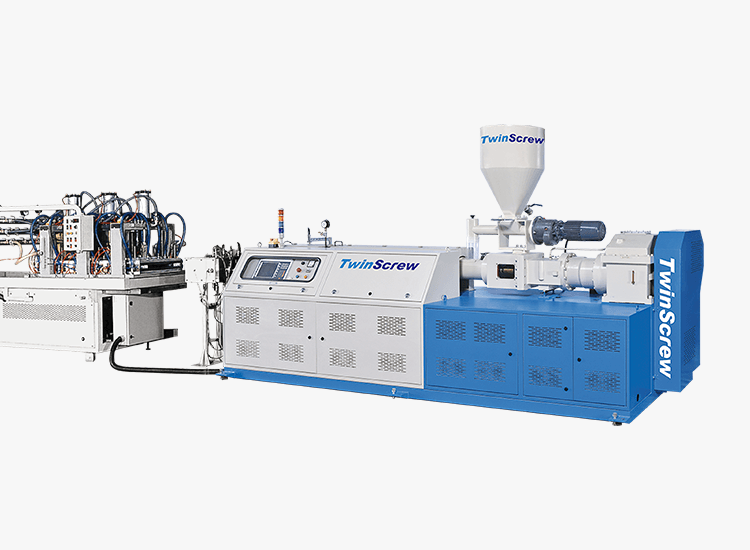
- Main extruder. Window work runs on our parallel counter-rotating twin screw extruder. Counter-rotating screws convey rigid dry blend positively and hold residence time short, which is what lets a multi-chamber die run at output without degrading the melt in the thin inner walls.
- Extrusion tool. Segment-type dies machined from stainless steel alloy with independently heated zones. A window die has to deliver melt evenly to chamber walls of different thickness in the same section, and zone control is what makes that possible.
- Vacuum calibrating system. Sectional calibration on a common base plate, each section with its own vacuum and cooling water connection. Chamber geometry is set here, not at the die, which is why calibration length rather than extruder size usually limits how fast a window profile can run.
- Profile caterpillar haul-off. Pulls the profile at a speed matched to extruder output. Speed stability translates directly into wall thickness consistency, and wall thickness consistency is what decides whether the corner welds square.
- Saw and line control. Cuts to stock length in line. All six stations run off one operation control system, so extruder output, haul-off speed and cut length stay synchronized without an operator chasing them station by station.
FAQ
What is a PVC window profile extrusion line?
A PVC window profile extrusion line melts rigid PVC dry blend and forms it through a multi-chamber die into window frame, sash, mullion and bead sections, then sets the chambers under vacuum while the profile cools. A complete line runs six stations: dry blend preparation, extruder, die, calibrator, haul-off and saw.
Is this the same as a uPVC window making machine?
No. A window making machine cuts and welds profile into finished windows. An extrusion line produces the profile in the first place, from raw compound. Fabricators buy the former; profile manufacturers buy the latter.
Why is the reinforcement chamber the critical dimension?
Because it has to accept a bought-in galvanized steel channel, so its tolerance is fixed by a part you do not make. A chamber slightly narrow rejects the reinforcement even though the profile passes every outside measurement.
What makes a window profile fail to weld square?
Wall thickness variation along the length, usually traced to haul-off speed instability or uneven cooling in the calibrator. Welding fuses the wall, so thickness variation becomes weld strength variation and the fault appears at the fabricator's corner test.
Can one line make frame, sash and bead?
Yes, by changing the die and the matching calibrator. We dimension the whole system as one tool family so the sections mate, rather than tooling them separately as the range grows.
What do you need to quote a window profile line?
Three things: the profile drawings with the reinforcement chambers dimensioned, the wall thickness class you build to, and the output in kilograms per hour. Tell us how many sections are in the system and we will size the tooling program with the line.