English
 English

 Home
HomeHDPE and PE Pipe Extrusion Line
An HDPE pipe extrusion line melts high-density polyethylene pellets, forms them through a die head into a continuous tube, and holds the diameter under vacuum while the wall cools. Our lines cover 2 mm to 400 mm, which spans microduct and drip irrigation tubing at one end and buried water main at the other.
Diameter is what changes the line, not the material. A 20 mm pipe leaves the line on a coiler at high speed and the cooling tank is the easy part. A 400 mm pipe moves slowly, carries enough melt weight to sag before it solidifies, and needs cooling length and haul-off grip that a small line never has to think about.
Tell us the diameter range you want to cover, the wall thickness or pressure rating, and whether the output is coiled or cut to length. Those three answers decide the extruder size, the cooling length and the downstream configuration before anything else is specified.
Small Bore or Large Bore: One Material, Two Line Layouts
Buyers usually arrive asking for an HDPE pipe line and have a diameter range in mind that decides most of the machine. The split is worth settling first, because the downstream half of the line is different on each side of it:
| Small bore (roughly 2 to 63 mm) | Large bore (roughly 63 to 400 mm) | |
|---|---|---|
| Output form | Coiled on a winder | Cut to length, stacked |
| Line speed | High, cooling is rarely the limit | Low, cooling length sets the ceiling |
| Main risk | Ovality from coiling while still warm | Melt sag before the wall solidifies |
| Downstream | Winder, coil packer | Planetary cutter, semi-auto stacker |
| Typical product | Microduct, drip irrigation, gas service | Water main, sewer, mining and dredging |
A line specified for one end of that range will run the other end badly rather than not at all, which is the expensive version of the mistake. We size the extruder and the cooling against the widest diameter in your plan, then check the smallest one still runs at a sensible speed.
What an HDPE Pipe Line Produces
One line covers a family of pipe products, separated by diameter, wall thickness and the downstream equipment rather than by the extruder:
- Water supply and distribution pipe. Pressure-rated pipe for buried mains and building supply, cut to length in the larger diameters.
- Gas distribution pipe. Same construction with a colored stripe co-extruded onto the surface for identification.
- Drip irrigation and agricultural tubing. Small bore, coiled, high line speed.
- Cable duct and microduct. Thin wall with a low-friction inner layer where the cable has to be blown through.
- Sewer, drainage and industrial pipe. Larger diameters and heavier walls, usually the limit of what the line is sized for.
Two options are worth settling with the line rather than after it. A sub-extruder co-extrudes an identification stripe or a functional inner layer in the same pass, and an automatic feeding system keeps the hopper supplied without an operator, which matters more on a large-bore line where a starved extruder costs a whole length rather than a meter.
How HDPE Pipe Is Made
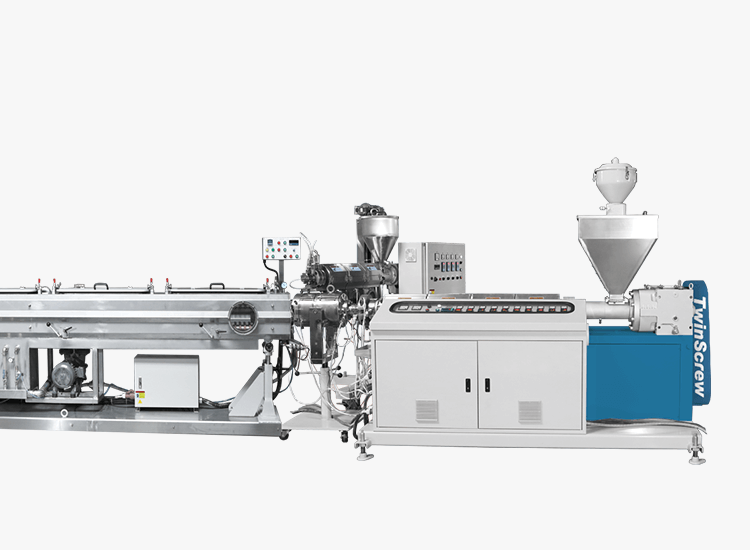
A complete HDPE pipe extrusion line runs six stations, each sized against the largest diameter in your range rather than the most common one:
- Automatic feeding. Pellets are conveyed to the hopper without manual charging, and any masterbatch is dosed here. Feed consistency is what keeps output steady, and output steadiness is what keeps wall thickness inside tolerance.
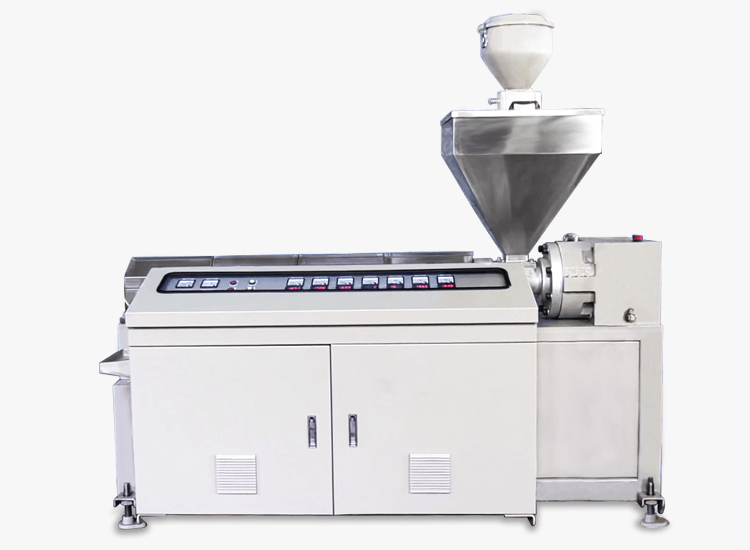
- Main extruder. A single screw extruder melts and homogenizes the polyethylene. Melt temperature uniformity across the screw matters more than peak output, because a hot streak in the melt becomes a thin spot in the wall a few meters later.
- Die head. A spiral mandrel die distributes the melt evenly around the full circumference. A sub-extruder can feed a co-extruded stripe or inner layer into the same die head, so identification and function are built in rather than printed on.
- Vacuum spray cooling tank. Vacuum holds the outside diameter against the sizing sleeve while spray water carries heat out of the wall. On large bore this station, not the extruder, is what limits line speed, and extending it is the usual way to raise output.
- Caterpillar haul-off. Pulls the pipe at a speed matched to extruder output, with grip spread over enough track length that the pipe is not deformed by the pulling force itself.
- Cutting and take-up. Small bore goes to a winder and is coiled. Large bore goes to a cutter and a semi-auto stacker. The changeover point between the two is a decision made when the line is specified, not later.
All stations run from one operation control system that synchronizes extruder output, haul-off speed and cutting length. Our product range covers 2 mm to 400 mm, and the line can be supplied as a complete solution from automatic feeding through co-extrusion to winding or stacking.
FAQ
What is an HDPE pipe extrusion line?
An HDPE pipe extrusion line melts high-density polyethylene pellets, forms them through a die head into a continuous tube, and cools it under vacuum to fix the diameter before cutting or coiling. Six stations: feeding, extruder, die head, cooling tank, haul-off, and cutting or winding.
What diameter range can one line cover?
Our lines cover 2 mm to 400 mm, but not all of it on one configuration. Cooling length, haul-off and take-up are chosen for a diameter band, so a coiled small-bore line is not the same machine as a large-bore one.
Why does cooling limit output on large pipe?
Because heat leaves a thick wall slowly. On small bore the extruder sets the pace; on large bore the pipe has to stay in the tank long enough for the wall to solidify through, so extending the cooling section raises output rather than fitting a bigger extruder.
Can the line co-extrude a colored stripe?
Yes. A sub-extruder feeds a second melt stream into the same die head, putting the stripe or a functional inner layer into the wall rather than onto the surface. It shares the die head, so it is specified with the line.
How does an HDPE line differ from a PVC pipe line?
The extruder and the cooling. Polyethylene runs on a single screw from pellets and holds heat, so it needs long cooling. Rigid PVC runs on a counter-rotating twin screw from dry blend and sets faster. The downstream stations look alike but are not interchangeable.
What do you need to quote an HDPE pipe line?
Three things: the diameter range, the wall thickness or pressure rating, and whether the output is coiled or cut to length. Tell us the material grade and we will specify the downstream stations.
Related Machines