English
 English

 Home
HomePVC Foam Board Extrusion Line
A PVC foam board extrusion line produces rigid PVC with a gas-expanded core, cut to board or run as a shaped section: skirting, architrave, window trim, cabinet panel and door slab all come off it. Density is the product. It sets weight, screw holding, surface hardness and cost per meter, and it is decided in the die and the cooling, not in the formulation alone.
Foam is the one profile where a line can hold every dimension and still make an unsellable product. A board at the wrong density either fails the nail test or costs more in resin than the market will pay, and neither shows up on a caliper.
Tell us the target density, the section, and whether you need a free foam, semi-skin or celuka structure. Those three answers set the die design and the cooling length before anything else is specified.
Free Foam, Semi-Skin and Celuka: Three Structures, Three Dies
Buyers usually arrive asking for "PVC foam board" and mean one of three different products. The structure decides the die, so it is worth settling first:
| Structure | Surface | Typical use |
|---|---|---|
| Free foam | Uniform cell structure, no distinct skin | Signage, light partition, low-cost panel |
| Semi-skin | Partly densified surface over a foamed core | General building board, furniture panel |
| Celuka (crust foam) | Hard dense skin over a light core | Skirting, trim, cabinet and door panel |
Celuka is where most profile work sits, because the hard skin is what lets a skirting board take a nail and a cabinet panel take a hinge screw while the core stays light. Getting that skin means cooling the outside of the section before the core finishes expanding, which is a die and calibration sequence rather than a recipe.
What a Foam Line Produces
One line covers a family of building products, separated by the die rather than by the machine:
- Skirting board and architrave. Celuka sections that replace painted timber and hold a fixing.
- Window and door trim. Narrow profiles run alongside the rigid window system.
- Cabinet and furniture panel. Wider sections where screw holding and edge finish decide acceptance.
- Foam board and sheet. Flat stock for signage, partition and interior fit-out.
Surface is added in line: our PVC wood-grained printing and ultraviolet (UV) curing equipment prints and cures a wood finish onto the skin, which is what turns a white celuka skirting into a product that competes with painted timber on appearance.
How PVC Foam Board Is Made
A complete PVC foam board production line runs six stations, each sized against your density target rather than your output target:
- Dry blend preparation. A high-speed mixer brings PVC resin, stabilizer, filler, processing aid and blowing agent to an even blend. Foam is less forgiving than rigid here: blowing agent that is unevenly distributed becomes density that is unevenly distributed, and there is no downstream station that corrects it.
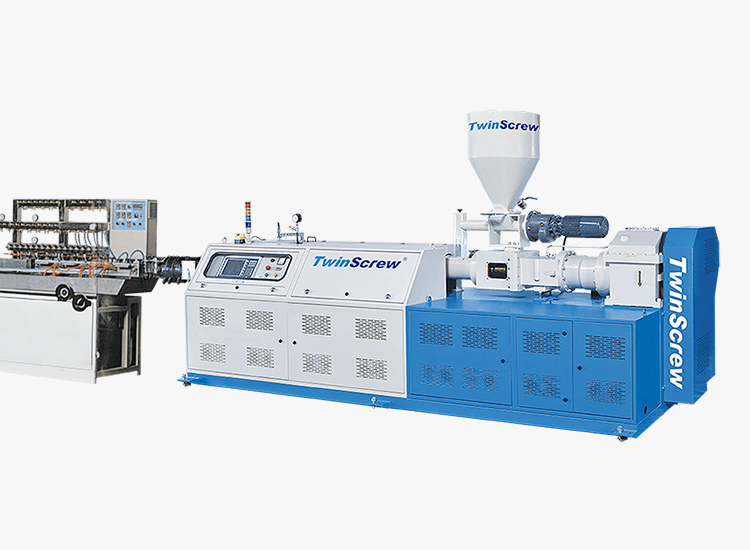
- Main extruder. Foam work runs on our parallel counter-rotating TwinScrew extruder. The screw has to build enough pressure to keep the blowing agent dissolved until the melt reaches the die, then release it in a controlled way, which is why residence time and pressure profile matter more here than raw throughput.
- Extrusion tool. Segment-type dies with independently heated zones. On a celuka section the die carries the mandrel or insert that forms the skin, so the tool is doing two jobs at once: shaping the section and deciding where the material densifies.
- Calibrating system. Sectional calibration on a common base plate, with its own vacuum and cooling water connections. Foam expands after the die, so the calibrator is setting final dimension against a section that is still growing, which is the opposite of what it does on a rigid profile.
- Profile caterpillar haul-off. Pulls the section at a speed matched to extruder output. On foam, haul-off speed is a density control: pulling faster stretches the cell structure and lowers density, so it is set to a product spec rather than only to line balance.
- Saw. Cuts to length in line, synchronized with the haul-off.
FAQ
What is a PVC foam board extrusion line?
A PVC foam board extrusion line melts rigid PVC dry blend containing a blowing agent and forms it through a die into a gas-expanded section or board, then sets the dimension under vacuum while it cools. A complete line runs six stations: dry blend preparation, extruder, die, calibrator, haul-off and saw.
What is the difference between free foam, semi-skin and celuka board?
The surface. Free foam has a uniform cell structure with no distinct skin, semi-skin has a partly densified surface, and celuka has a hard dense skin over a light core. Celuka is what skirting, trim and cabinet panel use, because the skin holds a fixing while the core stays light.
What controls the density of a foam board?
The die and the cooling, more than the formulation. Blowing agent sets how much gas is available; the die geometry and the rate the section is cooled decide how much of it stays as expansion and where the material densifies. Haul-off speed trims the result.
Why does a foam profile fail even when the dimensions are right?
Because density is not a dimension. A skirting board at too low a density will not hold a nail, and one at too high a density costs more in resin than the market pays. Both pass a caliper check and both come back from the customer.
Can the same line make skirting board and flat foam board?
Changing the die and the matching calibrator changes the section. Shaped profile and flat stock have different cooling requirements, so we check the full product range before sizing the line.
What do you need to quote a foam line?
Three things: the target density, the section or board dimensions, and the structure you need, free foam, semi-skin or celuka. Tell us whether the surface will be printed and we will specify the downstream stations with the line.
Related Machines