A PVC rain gutter extrusion machine turns rigid polyvinyl chloride (PVC) dry blend into finished gutter lengths in one continuous pass: melt, die, vacuum calibration, haul-off, cut. The gutter runs along a roof edge, catches rainwater and carries it clear of the foundation, and it has to seal against injection-molded outlets, corners and downpipe adapters at every joint.
Which is why output is the wrong number to specify a gutter line on. What decides whether a production run installs or goes to scrap is how closely the extruded section holds to the fittings it has to mate with, and that is set by the die and the calibration table.
Send us the gutter cross-section, the wall thickness, and the fittings you plan to pair it with. We size the extruder, the die and the calibration length around those three before anyone talks about floor space.
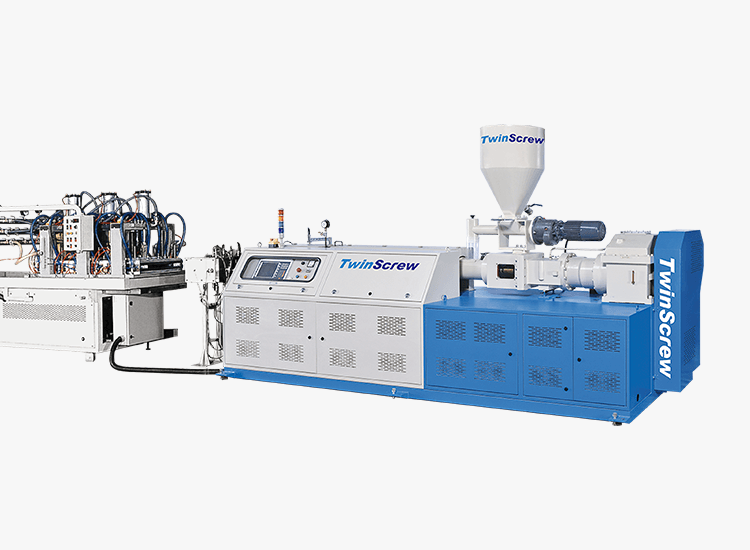
Most machines sold as "gutter machines" are roll formers: they feed aluminum or steel coil through a set of rollers and bend it into a gutter profile, usually on a truck at the job site. We do not build those. A PVC rain gutter extrusion machine melts polymer and forms the section through a die, and it belongs in a factory producing stock lengths for distribution.
The two processes answer different business models, and the split is worth checking before you shortlist any supplier:
| PVC extrusion | Metal roll forming | |
|---|---|---|
| Material | Rigid PVC compound | Aluminum or steel coil |
| Where it runs | Factory, continuous production | Job site, on demand |
| Output form | Cut stock lengths, sold through distribution | Seamless runs cut to the roof |
| Who buys the machine | Building-products manufacturers | Gutter installation contractors |
| Color and finish | Compounded in, or printed and coated in line | Pre-painted coil |
If you are producing gutter to sell through builders' merchants rather than installing it yourself, extrusion is the process you are looking for, and the rest of this page describes what that line looks like.
A complete PVC rain gutter production line runs six stations in sequence, and every one of them is specified against your cross-section rather than picked off a catalog page:
When the gutter needs a wood-grain or weather-resistant surface, our PVC wood-grained printing and ultraviolet (UV) curing equipment goes in after the saw. Specify it with the line rather than retrofitting it, because adding it later means re-sequencing the floor layout.
A gutter extrusion machine is a production line that melts rigid polyvinyl chloride (PVC) dry blend, forms it through a shaped die into a continuous gutter section, and holds that section under vacuum while it cools. A complete line runs six stations: dry blend preparation, main extruder, extrusion tool, vacuum calibrating system, caterpillar haul-off and saw.
PVC rain gutters are extruded, not bent. Dry blend is melted in a twin screw extruder, pushed through a die shaped to the gutter section, drawn into a vacuum calibrator that fixes the shape as it cools, pulled by a caterpillar haul-off and cut to stock length. Metal gutters, by contrast, are roll formed from coil.
Rigid PVC arrives as dry blend and degrades with heat history. A parallel counter-rotating twin screw conveys dry blend positively and keeps residence time short and predictable, while a single screw relies on friction to convey and is harder to hold at a stable melt temperature.
Through sectional vacuum calibration. The calibrator is split into sections mounted on a common base plate, each with its own vacuum and cooling water connection, so the lips of the open section stay held apart until the wall is rigid enough to keep its own shape.
Yes. Changing the die and its matching calibrator changes the section, and the extruder, haul-off and saw stay in place. Sizes far apart in width or wall thickness need different calibration lengths, so we look at your whole product range before sizing the line.
Three things: the cross-section drawing, the wall thickness, and the output you need in kilograms per hour. Tell us which injection-molded fittings the gutter has to mate with and which market it is going to, and we can settle tolerance and compound at the same time.
