 English
 English


 Home


Extruder Screw and Barrel Guide: Types, Design, Materials, and When to Replace
- What an Extruder Screw and Barrel Does, and Why It Matters
- Single-Screw and Twin-Screw Barrels at a Glance
- Screw Geometry: L/D Ratio, Compression Ratio, and Channel Depth
- Counter-Rotating Twin Screws: Where the Forces and the Wear Go
- Screw and Barrel Materials: Nitrided, Bimetallic, and Coated
- When to Replace an Extruder Screw and Barrel
- Questions to Ask a Screw and Barrel Supplier
- Screw Barrel: Frequently Asked Questions
- Get the Right Screw and Barrel for Your Line
An extruder screw and barrel are the matched pair that does most of the work inside an extruder. Together they convey the plastic, melt it, mix it, and build the pressure that pushes it through the die. How well they do that job depends on one small dimension, the clearance between the screw flights and the barrel wall.
As the screw and barrel wear, that clearance grows. Melt starts to slip back over the flights, output per screw turn drops, and melt temperature rises, often well before anyone thinks to pull the screw. That is why it pays to choose the right layout, geometry, and material for your compound from the start, and to keep the inspection report that comes with a new set. Every later wear check compares your measurements with those as-new dimensions. A drop in output per screw turn or a rise in melt temperature is your cue to stop and measure.
What an Extruder Screw and Barrel Does, and Why It Matters
An extruder screw turns inside a heated barrel. It carries pellets or powder forward, melts them through shear and barrel heat, mixes the melt, and pumps it to the die.
On a standard single screw, this work happens in three sections, and the channel gets shallower from one to the next:
- Feed section: moves solid pellets or powder away from the hopper.
- Compression section: the shallower channel packs the material together and melts it.
- Metering section: delivers the melt to the die at a steady pressure.
The screw and barrel do the conveying, melting, and pressurizing, so they control three things that nothing downstream can fix: output per screw turn, melt temperature and consistency at the die, and how long that performance lasts. Wear hurts all three at once. As the screw wears, its flights get smaller while the barrel bore gets larger. The gap between them widens, and melt leaks backward over the flights instead of moving forward.
We make both the screws and the barrels in-house, along with the gearboxes that drive them. Our extruder screws and barrels are machined from alloy steel imported from Germany or Japan. We position the barrel bores on special boring machines and finish them on computer numerical control (CNC) lathes, so every screw is matched to its own barrel. How a screw and barrel are built, and later inspected, depends first on one question: does the extruder run one screw or two?
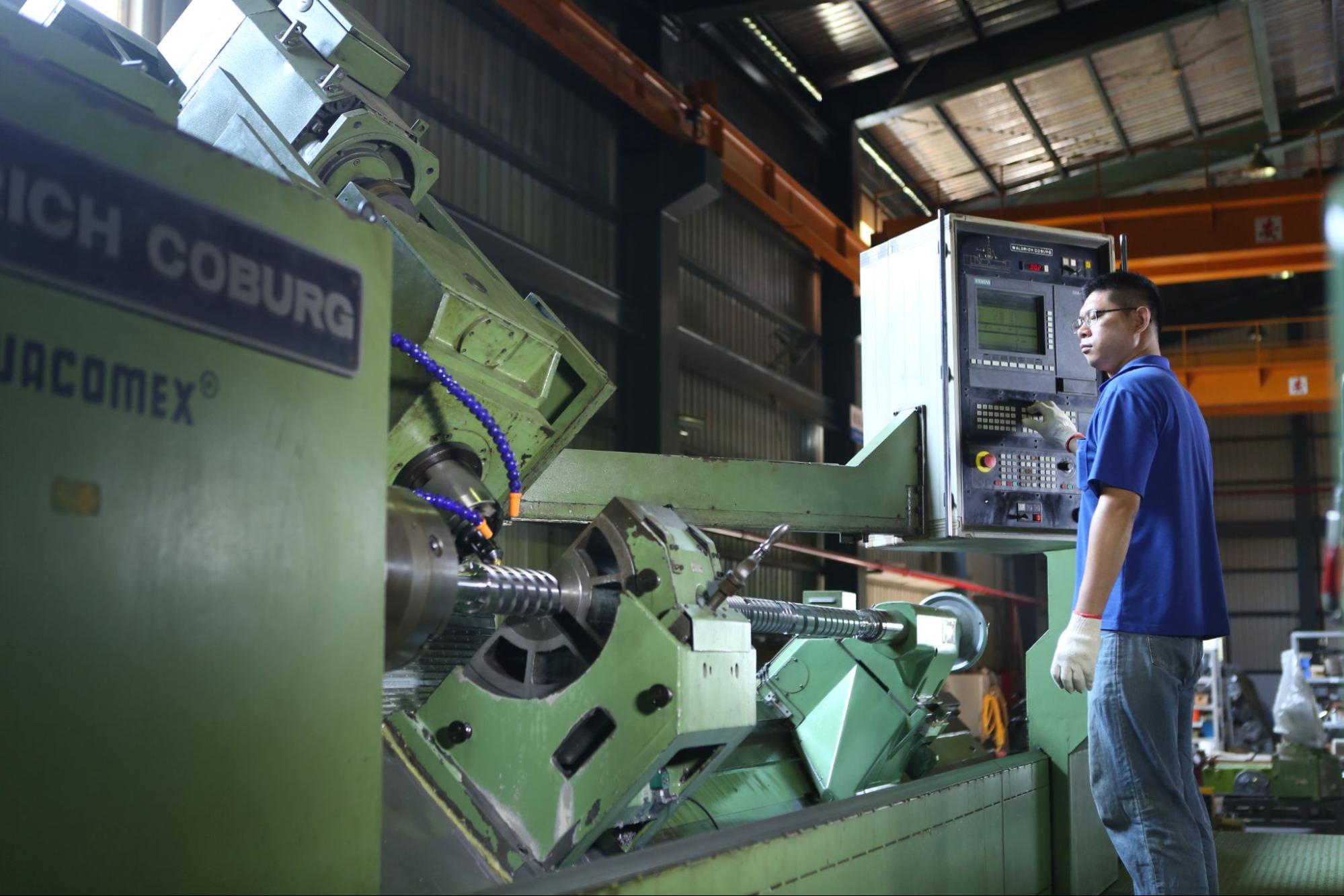
Screw flights are cut on CNC thread milling machines in our own factory.
Single-Screw and Twin-Screw Barrels at a Glance
A single-screw extruder runs one screw in a round barrel bore. A twin screw barrel has a figure-eight bore that holds two intermeshing screws. The shape of the bore affects where wear shows up and how many measurements it takes to find it.
| Layout | Barrel bore | Screws | Where it fits |
|---|---|---|---|
| Single screw | Single round bore | One screw | Single-screw extruders and pelletizers |
| Parallel twin screw | Twin bore, constant diameter | Two parallel screws, co-rotating or counter-rotating | Continuous production of profiles and pipes |
| Conical twin screw | Twin bore, tapered | Two screws that taper from the feed end toward the discharge end | Lines that use the taper as a built-in compression zone |
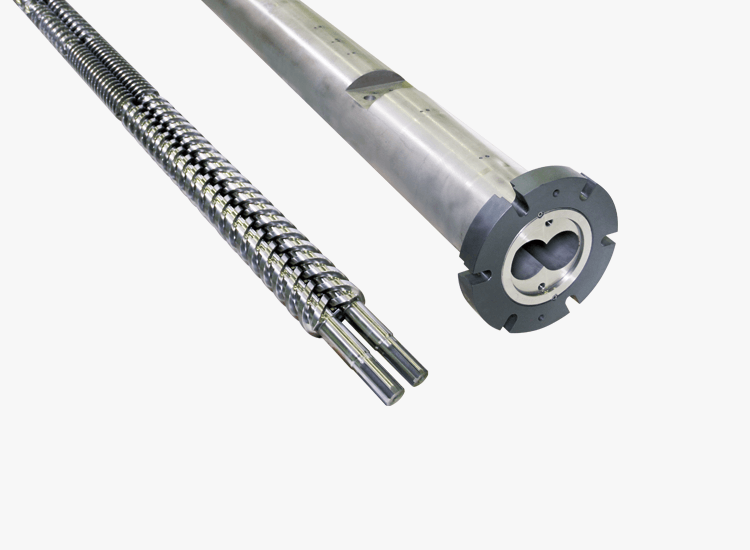
A parallel twin screw set and its twin-bore barrel. The figure-eight bore holds both screws.
Twin screws also differ in which way they turn. Co-rotating screws turn in the same direction, and counter-rotating screws turn in opposite directions. Our parallel counter-rotating twin screw extruders are built for rigid polyvinyl chloride (PVC) profiles, PVC pipe, and wood-plastic composite (WPC) boards. The differences between these layouts go well beyond the bore, and our guide to the types of twin screw extruders covers them in detail. Whatever the layout, the screw's geometry determines how the material melts.
Screw Geometry: L/D Ratio, Compression Ratio, and Channel Depth
Five design parameters shape how an extruder screw performs: diameter, length-to-diameter (L/D) ratio, compression ratio, channel depth, and flight pitch. Each one changes how the screw conveys, melts, and pressurizes the material:
- Diameter sets how much the screw can produce. A larger screw moves more material with every turn.
- L/D ratio is the flighted length of the screw divided by its diameter. A longer screw gives the material more distance to melt, mix, and vent before it reaches the die.
- Compression ratio compares the channel depth in the feed section with the depth in the metering section. It is only a ratio, so two screws with the same compression ratio can still have different channel depths and section lengths.
- Channel depth is the distance from the top of the flight to the root of the screw. A shallower channel puts more shear into the material. In the feed section, depth also decides whether powder feeds smoothly. On our counter-rotating extruders, the feed-zone depth is chosen to stop rigid PVC powder from bridging.
- Flight pitch is the distance from one flight to the next. Flight clearance is the gap between the flight tips and the barrel bore, and it is the dimension that wear changes.
Our TSE series of parallel counter-rotating twin screw extruders shows how output grows with screw diameter when the L/D ratio stays the same:
| Model | Screw diameter | L/D ratio | Maximum output |
|---|---|---|---|
| TSE-75 | 75 mm | 25:1 | 200–300 kg/h |
| TSE-90 | 90 mm | 25:1 | 300–500 kg/h |
| TSE-110 | 107 mm | 25:1 | 500–700 kg/h |
| TSE-130 | 132 mm | 25:1 | 950–1,200 kg/h |
We adjust pitch, channel depth, L/D ratio, and compression ratio to suit each raw material and application, and we use our test plant to recommend screw geometry for a given process. Geometry is only one factor in output quality. Formulation, the barrel temperature profile, and feed rate matter too, as our article on the factors that affect PVC extruder output quality explains. On a counter-rotating twin screw, geometry also affects the forces the screws put on the barrel and the gearbox.
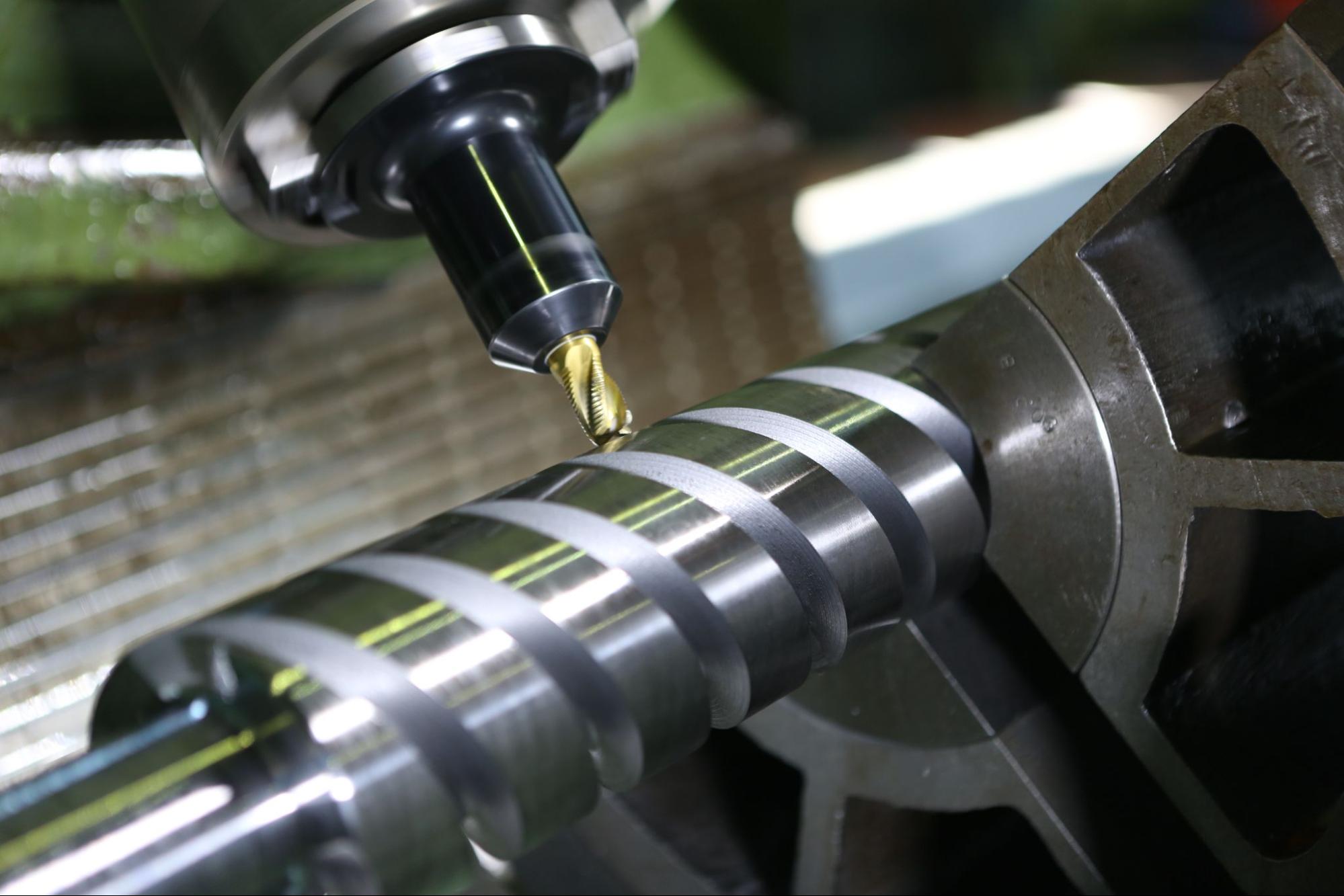
Pitch, channel depth, and flight profile are machined to the geometry set for each compound.
Counter-Rotating Twin Screws: Where the Forces and the Wear Go
In a counter-rotating twin screw extruder, melt is squeezed through the calender gap between the two screws. This creates strong separating forces that push the screws toward the barrel wall, so the barrel wears in a predictable band instead of evenly. On barrels that process rigid PVC, the heaviest wear usually appears 30° to 60° from vertical on each bore, around the 10 o'clock and 2 o'clock positions. On larger extruders, the weight of the screws can shift this band a little further out.
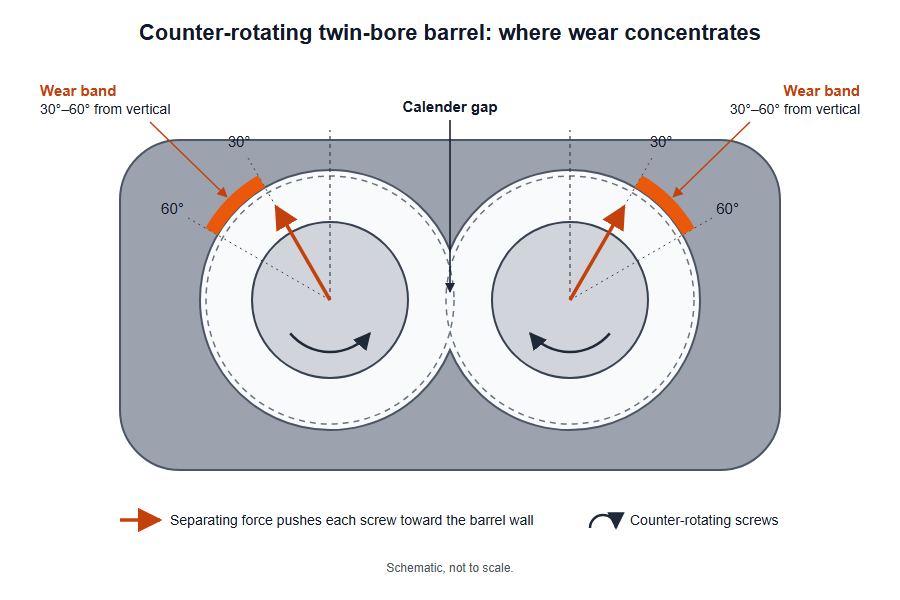
On a counter-rotating twin-bore barrel, the wear band sits 30° to 60° from vertical on each bore, so readings taken only at the top and bottom of the bore can miss it.
The same melt pressure also pushes the screws backward, and thrust bearings on the gearbox output shafts take that load. In a twin screw extruder, the two shafts sit close together, which leaves little room for those bearings. The low screw speeds of a counter-rotating extruder make their job harder still.
We build the screws, barrels, and gearboxes of our parallel counter-rotating twin screw extruders in-house, and our gearboxes use INA thrust bearings. Our senior engineers machine and fine-tune every screw set, barrel, and gearbox in our own factory. Forces decide where wear happens. Materials decide how fast it happens.
Screw and Barrel Materials: Nitrided, Bimetallic, and Coated
The material and surface treatment decide how long an extruder screw and barrel keep their clearance. The right choice depends on what is causing the damage: corrosion, abrasion, or both. Four options cover most cases:
| Option | What it is | Main protection |
|---|---|---|
| Nitriding | A hardened surface case diffused into alloy steel | A hard, wear-resistant surface for general duty |
| Hard chrome plating | A chromium layer plated onto the screw | Corrosion resistance |
| Tungsten carbide coating | A carbide layer applied to the flights | Abrasion resistance on the flight tips |
| Bimetallic lining or structure | A wear- and corrosion-resistant alloy bonded to the base steel | Wear and corrosion together, for demanding compounds |
Our standard nitrided screws and barrels meet these published specifications:
- Steel: nitrided steel to Japanese Industrial Standards (JIS) SACM 645 or Deutsches Institut für Normung (DIN) 34CrAlNi7.
- Treatment: long-time gas nitriding or ion nitriding.
- Surface hardness: Rockwell C hardness (HRC) 65 or higher, equivalent to Vickers hardness (HV) 900 or higher.
- Hardened depth: 0.6 mm or more.
- Surface roughness (Ra): 0.8 µm or less on the screw, 0.4 µm or less on the barrel bore.
- Straightness: 0.05 mm or less.

Boring, hardness, roughness, and straightness checks behind the specifications above.
For tougher applications, we also build bimetallic screws and barrels, with nickel-based or tungsten-chromium-based alloys bonded to the base steel. By our figures, they last two to three times longer, especially with glass-fiber-reinforced or filled compounds. The best option for your line depends on what you run through it.
Matching Screw and Barrel Material to PVC, Filled, WPC, and Recycled Compounds
Start with the biggest threat in your compound. Rigid PVC is the classic corrosion problem, because it releases hydrogen chloride (HCl) as it breaks down. Fillers and glass fiber, on the other hand, wear away the flights and the bore.
| What you process | Main threat | Typical direction |
|---|---|---|
| Unfilled general-purpose resins | Moderate wear | Nitrided steel |
| Rigid PVC | Corrosion from HCl | A corrosion-resistant surface, such as hard chrome or a bimetallic liner |
| Calcium carbonate-filled PVC | Corrosion and abrasion together | Bimetallic structures and liners |
| WPC with a PVC matrix | Filler wear plus corrosion from the PVC | Bimetallic structures and liners |
| Glass-fiber-reinforced compounds | Abrasion | Bimetallic structures or tungsten carbide on the flights |
| Recycled material with contamination | Abrasion from foreign particles | Wear-resistant flights and a bimetallic barrel |
If your compound is heavily filled, tell your supplier the filler type and percentage before you choose a material, because it changes which option makes sense. For more on how twin screw extruders handle PVC, see our PVC twin screw extruder basics. Even the right material wears out eventually, so the next question is how to tell when a screw and barrel have reached their limit.
When to Replace an Extruder Screw and Barrel
An extruder screw and barrel are due for a rebuild or replacement when the wear, measured against their as-new dimensions, costs more in output and quality than a repair would. No single number fits every line, but two process signals tell you when it is time to measure.
The first signs of wear are a drop in specific rate and a rise in discharge temperature. Specific rate is the extruder's output divided by its screw speed. Before you blame the screw, rule out other causes that look the same: a new resin lot or formulation, a failed heater band, or an uneven feed.
Measuring takes two tools. For the screw, measure the flight outside diameter (OD) flight by flight with an OD bar micrometer. Lay a tape measure along the screw so each reading is tied to a position. Clean the flights with brass tools and copper gauze, and let the screw cool to room temperature first.
For the barrel, read the inside diameter (ID) with an electronic micrometer mounted on a sled, usually moving it one L/D at a time along the bore. Measure each bore of a twin barrel separately, and on a counter-rotating barrel, take readings inside the 30° to 60° band described above.
Compare every reading with the as-new dimensions on the inspection report or the original drawing. These are the common signs that a screw or barrel is due:
| Part | What to measure | When to act |
|---|---|---|
| Screw | Flight clearance vs. as-new | Grown enough to hurt output or product quality |
| Screw | Hard facing on flight tips | Worn off completely |
| Screw | Rate loss and discharge temperature rise | Reaches an uneconomical level |
| Barrel | Bore inside diameter | Worn so far that a new screw would still run loose |
The right threshold depends on the job. A noncritical product like corrugated pipe can still come out fine from a heavily worn screw, while a medical process may need a new screw after much less wear. Screws are also designed to wear faster than barrels, because the screw is the easier part to replace.
Reaching a threshold does not always mean buying new parts. A worn screw can often be rebuilt with new hard facing, but no screw should be refurbished more than three times. Each new weld weakens the base metal and raises the risk of the hard facing peeling away. A worn barrel can often be relined.
Keeping a spare screw on hand means the line does not sit idle during a rebuild. We keep screw sets in stock for our customers, which saves about two months of lead time, and our repair services cover regrinding, relining, and refurbishment.
How long a screw and barrel last depends on what they run. One TW-90 profile extrusion line we built for cable trunking has been running for about 28 years under two owners. In that time, its screw and barrel have been replaced only once. When wear began to affect product quality in 2023, the current owner came back to us for a new set and a spare, as described in this service case.
Cases like this show why the as-new dimensions matter. Without them, no one can tell how far a screw and barrel have worn, or what a replacement should match.
Questions to Ask a Screw and Barrel Supplier
When you buy an extruder, or a replacement screw and barrel, two questions matter most: who makes the screw, barrel, and gearbox, and how quickly can they supply a matched spare?
Questions to Ask When You Buy an Extruder
Ask these six questions before you compare prices. The answers decide what the extruder will cost to keep running:
- Who makes the screw, barrel, and gearbox? A maker that machines all three controls how well they fit together, and can supply matching replacements years later.
- Which materials and surface treatments are available? Look for stated hardness, nitriding depth, and bimetallic options, not a general promise of wear resistance.
- Can the screw geometry be tailored to your formulation? A screw designed for one compound may underperform on another.
- Does every screw and barrel ship with an inspection report? Those dimension and concentricity records become your baseline for every future wear check.
- Are spare screw sets kept in stock, and what is the lead time? A spare on the shelf is the difference between a planned changeover and a stopped line.
- Can the maker still supply parts for older models? Extruders often outlast their first owners, and their parts need to as well.
What to Send for a Replacement Screw and Barrel
A replacement screw and barrel can only be built right with complete information. Before you ask for a quote, gather the following:
- Machine: make, model, and year of the extruder.
- Layout: single or twin screw; for twin screws, parallel or conical, and co-rotating or counter-rotating.
- Size: screw diameter and L/D ratio.
- Material: the resin you run, plus filler type and content.
- Reference: the original drawing, or the worn screw if there is no drawing.
- Wear data: your latest flight OD and bore ID readings.
- Process data: current output, screw speed, and melt temperature, compared with the figures from when the screw and barrel were new.
With this information, a supplier can confirm fit, recommend a material, and tell you whether a rebuild is possible. We build extruder screws and barrels to order for single-screw and twin-screw extruders, and every set ships with an inspection report. A few questions come up on almost every order, and the most common ones are answered below.
Screw Barrel: Frequently Asked Questions
These are the questions buyers and maintenance teams ask most often about extruder screws and barrels:
Q1: What is a barrel in an extruder?
An extruder barrel is the heated steel cylinder that surrounds the screw. It holds the heating zones, contains the melt pressure, and, together with the screw flights, sets the clearance that controls how efficiently the extruder pumps.
Q2: What are the different types of extruder screws?
Extruder screws are either single screws or twin screws. Twin screws come in parallel or conical layouts and turn either in the same direction (co-rotating) or in opposite directions (counter-rotating). The barrel bore matches the layout: round for a single screw, figure-eight for a twin screw.
Q3: What are the main uses of a screw barrel?
A screw barrel conveys, melts, mixes, and pressurizes plastic or rubber before it reaches the die. Our screws and barrels are used in plastic extrusion, compounding, injection molding, and rubber processing.
Q4: What does L/D ratio mean for an extruder screw?
The L/D ratio of an extruder screw is its flighted length divided by its diameter. A higher L/D gives the material more distance to melt, mix, and vent. All four models in our TSE series of parallel counter-rotating twin screw extruders use 25:1.
Q5: How long does an extruder screw and barrel last?
An extruder screw and barrel last as long as the clearance between them stays within what your process can tolerate. Service life depends on the material you run, its filler content, and the surface treatment. One of our TW-90 profile lines has needed only one screw and barrel replacement in about 28 years.
Q6: Can a worn extruder screw be repaired?
A worn extruder screw can often be repaired by restoring the hard facing on its flights, as long as the base metal is sound. A screw can be refurbished up to three times, and a worn barrel can often be relined instead of replaced.
Get the Right Screw and Barrel for Your Line
The right screw and barrel depend on details no general guide can cover: the compound you run, the output you need, and, on an existing line, how far the current set has worn. For a new line, tell us the product, the formulation, and your target output, and we will recommend a screw geometry and material.
For a replacement, send us the details from the checklist above through our contact form. In the message box, include the machine make and model, screw diameter and L/D ratio, the material and filler content you run, and any flight and bore measurements you have. Our engineers will tell you whether a rebuild, a relining, or a new set makes sense, and what to specify.
Related Articles


